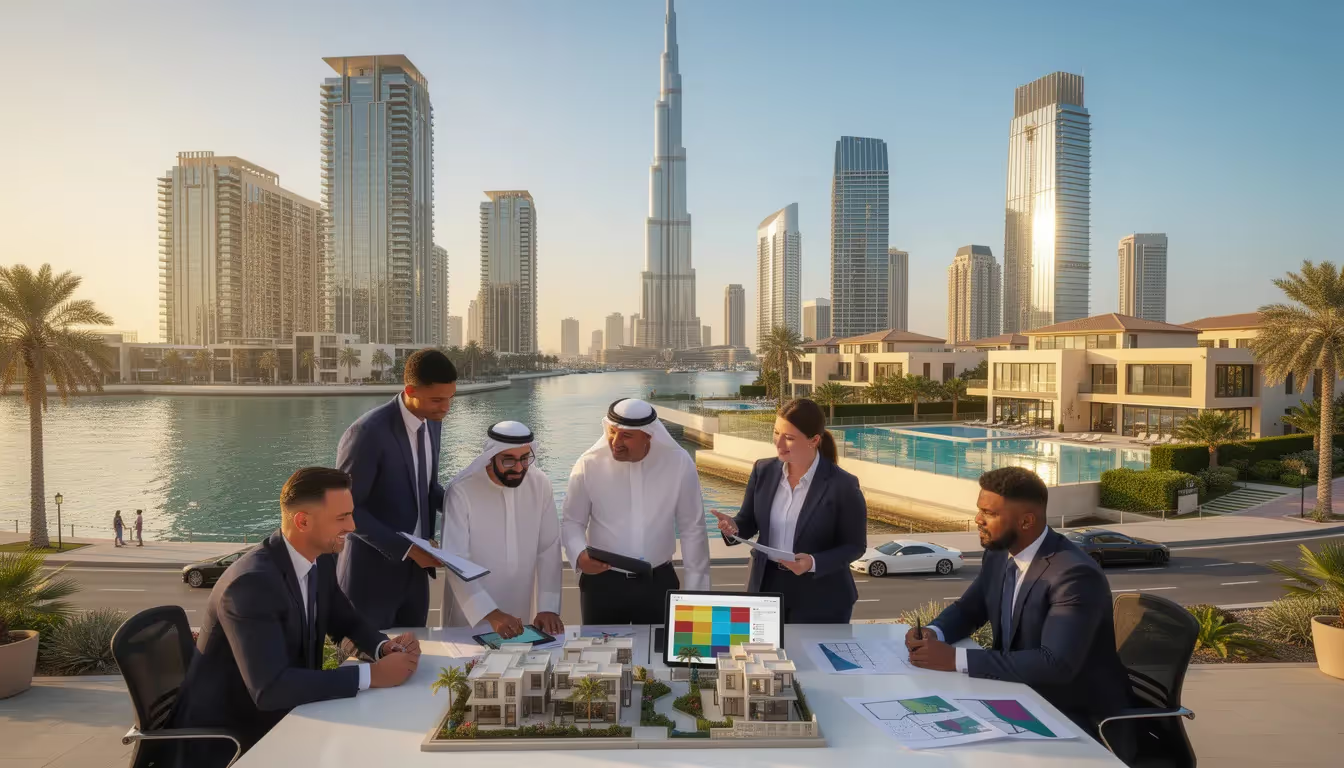

Dubai Real Estate Inheritance Law: Why DACH owners need a DIFC will
Without a registered will, local law determines the fate of your property in Dubai. Here is what owners from Germany, Austria, and Switzerland need to know about DIFC wills, the process, and taxes.

This article is for general information purposes only and does not constitute legal or tax advice. All information is based on the status at the time of writing. Legal regulations, fees, and procedures are subject to change.
Before buying, investors from Germany, Austria, and Switzerland carefully check yields, locations, and developers. Yet, almost no one asks the crucial question: What happens to the property if the owner passes away?
The answer is uncomfortable. Your will from Germany does not automatically cover your apartment in Dubai. A separate legal system applies to real estate located in the UAE, and it will prevail in case of doubt. If you do not make arrangements, you leave your family to face proceedings in a foreign court, in a foreign language, with your assets frozen.
This article explains why this is the case, what instrument is available to prevent it, and exactly what it costs.
Key takeaways
- For real estate in the UAE, Article 17(5) of the UAE Civil Code dictates that UAE law takes precedence, even over a foreign will.
- Without a registered will, the local courts of the emirate where the asset is located will make the decision.
- The DIFC Will is an English-language, common-law-based will created specifically for non-Muslims with assets in the UAE.
- Residency or a visa in the UAE is not required for registration. The notarization can be completed via a video appointment.
- The UAE does not levy inheritance tax. Germany does, however, on your entire worldwide estate.
Why your German will is not enough in Dubai
What the EU Succession Regulation covers
Since August 17, 2015, the EU Succession Regulation (EU) No. 650/2012 has been in effect in Germany and Austria. It links succession to the deceased's last habitual residence. Its core principle is the unity of the estate: the entire estate should be subject to a single succession law, regardless of the nature of the assets and whether they are located in another member state or a third country. Additionally, the testator can choose the law of their home country.
From a German and Austrian perspective, the matter seems clear. The same inheritance law that applies to your house in Munich or your portfolio in Vienna should apply to your Dubai property.
Why this doesn't help in Dubai
The regulation only binds member states. The United Arab Emirates is a third country. From the UAE's perspective, its own conflict-of-law rules apply, which lead to a different result.
The decisive factor is Article 17 of Federal Law No. 5 of 1985 on Civil Transactions, as amended by Decree-Law No. 30 of 2020. While paragraph 1 generally subjects succession to the law of the deceased's nationality, paragraph 5 contains a restriction with significant impact: for a foreigner's will concerning real estate located within the state, UAE law takes precedence. Consequently, the inheritance law in Dubai is the governing factor for the property itself.
In practical terms, this means that a UAE court is not automatically required to implement the provisions you make in your German will regarding property in Dubai. A German certificate of inheritance or a European Certificate of Succession is not automatically recognized in the UAE. This creates a de facto split in the estate: authorities in your home country and those in Dubai will assess the same inheritance case according to different laws.
What has changed since 2023 and what has not
Federal Decree-Law No. 41 of 2022 on Civil Personal Status for non-Muslims came into effect on February 1, 2023, significantly improving the situation. Article 11 grants the testator the right to freely dispose of all their assets within the state. In the absence of a will, the surviving spouse receives half, and the other half is divided equally among the children, with no distinction between sons and daughters. For a married couple with children, this results in a 50/50 split. Furthermore, under Article 11(3), heirs of a foreign national may request the application of the law of their home country, provided no registered will dictates otherwise.
This does not apply to Muslim testators. For them, inheritance distribution remains governed by Sharia law, where sons typically receive double the share of daughters and testamentary freedom is restricted. The testator's status is therefore the primary factor, and it should be documented.
However, the same fundamental problem exists in both cases. Without a will, distribution follows rigid statutory quotas. What is taken for granted in German-speaking countries—namely, securing the surviving partner first, as provided for in a "Berlin will"—cannot be replicated in this way.
The decisive point regarding real estate lies in the scope of the law. It explicitly applies without prejudice to Articles 12, 13, 15, 16, and 17 of the 1985 Civil Code. Article 17 therefore remains unaffected, meaning that UAE law continues to take precedence for real estate.
The legal situation has eased for movable assets. However, this only applies to a limited extent to the property itself, which is usually the primary asset for an investor. This is precisely why a locally registered will remains the most reliable instrument.
What actually happens in the meantime
Following the owner's death, any disposal of the property is blocked until the heirs or the beneficiaries named in the will are determined.
Bank accounts in the UAE are frozen until legal succession is clarified. For joint accounts, the remaining holders must notify the bank within ten days.
Proceedings before the Dubai Courts are conducted in Arabic. Foreign documents must be legalized and submitted with a translation.
If there is an active mortgage, the Land Department requires a no-objection certificate from the bank before the title can be transferred.
The DIFC Will: Structure, Requirements, and Costs
The DIFC Courts Wills Service is a joint initiative of the Government of Dubai and the DIFC Courts, the courts of the Dubai International Financial Centre. It was established by Resolution No. 4 of 2014 and confirmed by Dubai Law No. 15 of 2017 on the administration and enforcement of wills for non-Muslims. This law provides for a register of wills for non-Muslims at both the Dubai Courts and the DIFC Courts.
The difference from the local route is practical in nature. The DIFC will is drafted in English, follows common law principles, and is therefore much easier for investors from German-speaking countries to understand and manage.
Who can register a DIFC will
- You are not a Muslim and have never been one.
- You are at least 21 years old.
- You own assets in the UAE or have minor children living there with you.
Residency in the UAE is explicitly not required. A visa is also not necessary. For investors from Germany, Austria, and Switzerland who hold an off-plan unit without ever having lived there, this is the decisive factor.
Types of wills and fees
Source: DIFC Courts, Schedule of Fees, Article IX. As of August 3, 2026. DIFC Courts fees are not subject to VAT. Subsequent amendments cost 550 AED per will. A booking fee applies to every charge, which is credited toward the service fee but is forfeited in the event of cancellation. Legal fees are not included and are charged separately.
For most DACH investors with one or two units and no other assets in the UAE, the Property Will is the ideal solution. Those who frequently acquire new properties or hold local accounts and shares are better served by a Full Will. The reason lies in a detail that can save significant costs later on.
The difference that matters for off-plan properties
A Property Will covers only the specific properties listed by name at the time of registration. If you purchase another unit later, you must register a new will. A Full Will, by contrast, covers all movable and immovable assets within the specified jurisdiction at the time of death, regardless of whether they were mentioned at the time of registration.
For off-plan buyers, there is another point that few people are aware of. A property under construction can be included in a Property Will as soon as the RERA Oqood certificate is issued. A Title Deed is not required for this. With a Full Will, no proof of ownership is required at the time of registration anyway.
This means protection is possible not just after handover, but shortly after reservation. Anyone investing today in a project from our project portfolio can arrange their succession in parallel with the first payment installment, rather than waiting three or four years for handover.
How the registration process works
- Draft the will. You can use your own draft, one of the Wills Service online templates, or hire a registered Wills Draftsman. The Property Will, Business Owners Will, and Financial Assets Will must be created using the online template.
- Upload documents. Passport, Emirates ID (if applicable), and passport copies of the two witnesses. For a Property Will, also include the Title Deed or Oqood certificate for each property.
- Book an appointment and pay the fee. Booking is done via the Wills Service online portal. The appointment can be attended online or in person at the DIFC Courts offices.
- Attend the video appointment. The testator and two witnesses participate via video conference from anywhere in the world. Witnesses must be at least 21 years old and cannot be beneficiaries, guardians, or their spouses.
- Sign electronically. The appointment takes about twenty minutes. The electronically signed will is considered the original; no paper version is maintained. A copy is available for download immediately after the appointment.
Practical note for German-speaking investors
The DIFC Courts Wills Service does not permit interpreters or powers of attorney during the attestation process. The testator and witnesses must be able to follow the appointment in English.
If you do not feel comfortable with this, you should go through the draft in full beforehand with German-speaking assistance so that the appointment is merely a confirmation.

What actually happens in the event of death
If a registered DIFC will is in place, the process is streamlined and generally much faster than it would be otherwise.
- The appointed executor submits the death certificate to the DIFC Courts and is guided through the probate process.
- The court issues a Grant of Probate. The fee is 1,500 USD. In straightforward cases, the DIFC Courts typically issue the order within a few weeks.
- With the court order and the corresponding letter to the Dubai Land Department, the property is transferred to the beneficiaries.
The costs of the transfer are the pleasant part of the process. For property transfers in the event of death, the Dubai Land Department charges 1,000 AED per property, plus 250 AED for the issuance of the title deed, as well as fees for site plans and the appointed service center. The standard four percent transfer fee that applies to sales is not charged in cases of inheritance.
Requirements include, among other things, the court's determination of inheritance, the court's letter to the Dubai Land Department, identification documents for all heirs, and a no-objection certificate from the financing bank if the property is mortgaged, or from the developer if a purchase contract for an off-plan unit is still active. We have broken down how total incidental costs in Dubai are composed in our article on purchase costs and DLD fees .
Taxes: Dubai levies none, but your home country might
The United Arab Emirates does not have inheritance tax. However, this does not indicate the tax burden in your home country, and this is precisely where Germany, Austria, and Switzerland differ significantly.
Germany
According to the Inheritance and Gift Tax Act, unlimited tax liability applies if the deceased or the beneficiary is a resident of Germany. A resident is defined, in particular, as someone who has a domicile or habitual residence in the country. This covers the entire global estate, including the property in Dubai.
There is no double taxation agreement for inheritance tax between Germany and the UAE. Germany only maintains such special agreements with Denmark, France, Greece, Sweden, Switzerland, and the USA. Since the UAE does not levy inheritance tax, there is also no foreign tax that could be credited under Section 21 of the Inheritance and Gift Tax Act (ErbStG). Therefore, the value of the Dubai property is included in the German tax base without reduction.
Personal tax-free allowances remain unchanged. For spouses, this is 500,000 euros; for children, it is 400,000 euros per parent.
One point has changed in favor of investors. Section 13d of the Inheritance and Gift Tax Act (ErbStG) grants a ten percent valuation discount for properties rented out for residential purposes. Until 2024, this only applied to properties within Germany, the EU, and the EEA. After the European Court of Justice ruled on October 12, 2023, that this was a violation of the free movement of capital, the benefit was extended to third countries. A prerequisite is that an exchange of information regarding inheritance tax is secured with the country in question. The Federal Ministry of Finance publishes a list for this purpose. Whether the UAE is included must be checked on a case-by-case basis against the current version.
Austria
Austria has not levied inheritance tax since August 1, 2008. Consequently, no inheritance tax is due in Austria for the Dubai property. This difference compared to Germany is significant and is rarely presented clearly in the German-speaking market.
The inheritance law aspect remains unaffected by this. The EU Succession Regulation also applies in Austria, and the compulsory portion (forced heirship) remains in effect. A transfer of individual assets carried out in a third country does not preempt the assessment of the compulsory portion in Austria.
Switzerland
Inheritance tax in Switzerland is regulated at the cantonal level. Rates, tax-free allowances, and exemptions differ significantly; direct descendants are exempt in most cantons. For properties located abroad, the right to tax is usually assigned to the country where the property is located. The regulations of the canton of residence are decisive and must be checked on a case-by-case basis.
How rental income and capital gains are taxed in these three countries is the subject of our article on Dubai Real Estate and Taxes.
The compulsory portion remains, even with a DIFC Will
A common misconception is that a DIFC Will can be used to bypass the compulsory portion (forced heirship) in your home country. This is not the case.
In Germany and Austria, the compulsory portion is a monetary claim against the heir. It arises regardless of which country an individual asset is located in or to whom it was transferred there. The value of the Dubai property is included in the calculation. Anyone who bypasses a child via a DIFC Will is simply shifting the conflict to their home country.
This leads to the real task at hand. The DIFC Will and the last will and testament in your home country must be coordinated with each other. Two documents that contradict one another create more disputes than having none at all.
Two rules that many overlook
A subsequent marriage completely revokes a registered DIFC Will, unless the intention to marry that person is explicitly stated in the Will.
A subsequent divorce invalidates bequests and appointments in favor of the former spouse, but the rest of the Will remains in effect.
In both cases, re-registration is required. The amendment fee is 550 AED per Will.
Risks and open issues
An article on this topic would be incomplete if it only described the solution. These points should be part of every decision.
- The legal situation is in flux. Between 2020 and 2025, the Civil Code was amended, personal status law for non-Muslims was introduced, and the framework of the DIFC Courts was redefined. The UAE legal system is shaped by civil law and Sharia. Check the current status before any registration.
- Article 17(5) of the Civil Code leaves room for interpretation. This is precisely why a locally registered Will is a safer path than disputing applicable law.
- Without a Will, it is not your wishes that decide, but a statutory quota. For non-Muslims, these have been the rigid shares of Federal Decree-Law No. 41 of 2022 since February 2023; for Muslims, it is distribution according to Sharia.
- Multiple Wills can cancel each other out. A Will created later in your home country can render a DIFC Will ineffective if it is poorly drafted. Coordination is mandatory.
- Enforcement outside the UAE is not guaranteed. A Full Will can include foreign assets, but whether it is enforceable there depends on the law of the respective state.
- Minor heirs prolong every proceeding. Dispositions regarding their share require additional court approval.
- For financed properties, the remaining debt remains. Clarify in advance how your bank handles a death and whether life insurance is part of the loan.
- The registration fee is not the total cost. Legal fees, translations, and notarizations are additional.
The five most common mistakes
- Relying on a will from your home country. While it covers many things, it only has limited application to property located in the UAE. Until legal succession is settled, property and accounts remain frozen for your family.
- Waiting until handover. Off-plan units can be secured as soon as the Oqood certificate is available.
- Choosing a Property Will when further purchases are planned. Each additional purchase then requires a new registration.
- Failing to coordinate both wills. Conflicting provisions are the most common cause of lengthy legal proceedings.
- Failing to update after marriage, divorce, or the birth of a child.

Checklist for property owners
- Check requirements: non-Muslim, at least 21 years old, assets in the UAE.
- Choose the appropriate type of will based on the number of properties and planned future purchases.
- Gather documents: passport, title deed or Oqood, and passport copies of witnesses.
- Appoint two witnesses who are neither beneficiaries nor guardians, nor their spouses.
- Designate an executor and a substitute executor. Residency in the UAE is not required for this.
- Coordinate with your will in your home country through a specialist inheritance lawyer.
- Clarify tax implications in your country of residence in advance with a tax advisor.
- Book an appointment via the DIFC Courts Wills Service portal and attend via video call.
Frequently asked questions
Do I need a DIFC will if I don't live in Dubai?
Yes, provided you hold assets there. The DIFC Courts Wills Service does not require residency or a UAE visa. The only requirements are that you have assets in the country, are at least 21 years old, and are not—and have never been—a Muslim. Registration is completed entirely via video appointment.
Is my German or Austrian will valid in Dubai?
Only to a limited extent. Under Article 17(5) of the UAE Civil Code, UAE law takes precedence for real estate in the UAE. A German certificate of inheritance or a European Certificate of Succession is not automatically recognized there. Without a registered will, local courts will make the decision.
How much does a DIFC will cost?
The registration fee is 10,000 AED for a Full Will and 7,500 AED for a Property Will, for an individual. For married couples registering simultaneously, the fees are 15,000 AED and 10,000 AED, respectively. These fees are not subject to VAT. Legal fees may apply in addition. As of: August 3, 2026.
Can I include an off-plan property in my will?
Yes. For a Property Will, the Oqood certificate issued by RERA is sufficient; a Title Deed is not required. For a Full Will, no proof of ownership is needed at the time of registration, and it also covers assets acquired at a later date.
Is there inheritance tax on a Dubai property?
Not in the UAE. However, there is in Germany if there is unlimited tax liability, as this covers global assets and there is no inheritance tax treaty with the UAE. Austria has not levied inheritance tax since 2008. In Switzerland, the matter is regulated at the cantonal level. An individual assessment is required in every case.
What happens to an ongoing mortgage in the event of death?
The remaining debt remains and does not expire upon death. The Dubai Land Department will only transfer a mortgaged property once the financing bank has issued a no-objection certificate. Therefore, the heirs must either pay off or take over the financing. Clarify how your bank handles death and whether life insurance is part of the loan when you first sign the agreement.
How long does the probate process take?
In straightforward cases, the DIFC Courts state that they typically issue the Grant of Probate within a few weeks. The subsequent transfer at the Dubai Land Department costs 1,000 AED per property, plus deed and map fees. Experience shows that the process takes significantly longer without a registered will.
Conclusion
For most investors from Germany, Austria, and Switzerland, a property in Dubai is their only asset outside their familiar legal jurisdiction. Yet, this very asset is the least protected if no arrangements are made.
The effort is negligible compared to the risk. Registration takes about twenty minutes via video, costs between 5,000 and 15,000 AED depending on the type of will, and can be completed during the construction phase. What it prevents is proceedings before a foreign court at a time when the family is already under significant strain.
Anyone still considering a purchase should include this point in their due diligence. We explain how we check projects for legal security and structure under Dubai Real Estate Security. Our overview of locations in Dubaishows which areas are sustainable in the long term, and we explain how a purchase can be structured through partner banks under Real Estate Financing in Dubai.
Consulting
Life in Luxury assists investors from Germany, Austria, and Switzerland in acquiring vetted off-plan projects in Dubai. For succession planning, we can refer you to local lawyers listed in the DIFC Courts Wills Draftsmen registry. You can schedule a non-binding initial consultation via our consulting page or directly as a 30-minute investment call. We are also happy to answer brief questions via WhatsApp.
Legal Disclaimer
This article reflects the status as of August 3, 2026, and is based on publicly available sources, in particular publications by the DIFC Courts, the Dubai Land Department, and UAE legislation. It does not constitute legal or tax advice and is not a substitute for professional counsel. Fees, procedures, and legal requirements are subject to change. For individual cases, please consult a lawyer licensed in the UAE as well as a tax advisor specializing in international inheritance law.

Lukas Reinhardt
Editorial team
Lukas Reinhardt is a real estate writer focusing on international residential properties, investment locations, and the Dubai real estate market. He covers purchasing processes, location factors, market trends, and the regulatory framework relevant to buyers and investors from the DACH region.
.jpg)
Individual financing for Dubai real estate
We work with selected partner banks in the UAE and structure your financing individually — tailored to your budget, equity and investment goals.
100% no obligation
Investment-Beratung für Dubai Immobilien
Wir analysieren, welche Projekte die besten Voraussetzungen für langfristige Mieteinnahmen oder nachhaltige Wertsteigerung bieten. Ob Off-Plan oder Ready – wir entwickeln eine klare Investmentstrategie, die auf Ihre Situation abgestimmt ist.
Personalized investment strategy for Dubai real estate
Develop a tailored investment strategy for real estate in Dubai based on your needs, goals and risk profile. Get clear advice to get the best return on investment.
100% non-binding
.jpg)