
Palm Jumeirah Real Estate: Prices, Location, and Investor Insights
Palm Jumeirah real estate at a glance: prices, locations, property types, service charges, yield factors, and key considerations for investors.
Palm Jumeirah in Dubai is one of the most expensive residential areas in the world. For investors from Germany, Austria, and Switzerland, the question arises whether a property on this man-made island is truly a sensible capital investment or second home. This article provides an analytical overview of the location, property types, prices, running costs, and risks—without the sales rhetoric.
Key Takeaways
- Palm Jumeirah offers a variety of property types, including apartments, villas, penthouses, and branded residences—with significantly different price and yield profiles depending on the micro-location (Trunk, Fronds, Crescent).
- Specific pricing information should be based exclusively on official sources such as the Dubai Land Department (DLD) and current market reports. Asking prices on portals, registered transaction prices, and developer launch prices often differ significantly.
- High entry prices and above-average service charges are balanced by strong international rental demand. Rental yields can only be realistically assessed in the context of all running costs, vacancy rates, and management fees—market data shows annual gross yields for apartments often range between 5 and 7 percent, with net values being significantly lower depending on the project.
- Compared to areas like Dubai Marina, Downtown Dubai, or Dubai Harbour, Palm Jumeirah is primarily considered a lifestyle and trophy asset, not necessarily a yield maximizer.
- Figures and regulatory frameworks are constantly changing. Before any investment, it is recommended to check the latest data via Dubai REST, the DLD, and independent market reports.
Palm Jumeirah at a Glance
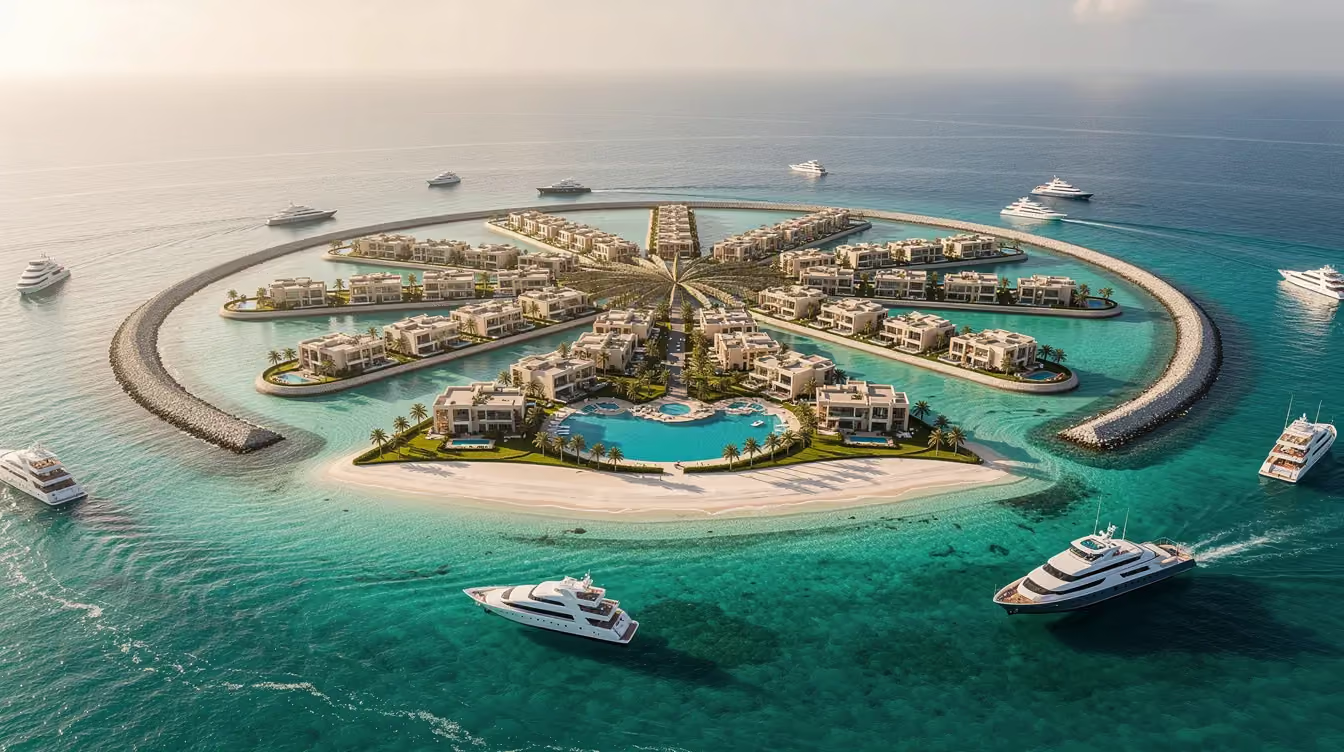
Palm Jumeirah is a man-made archipelago in the shape of a palm tree off the coast of Dubai in the United Arab Emirates. Developed by Nakheel Properties, a leading developer of luxury real estate in Dubai, the island extends five kilometers into the sea and offers spectacular views of the Persian Gulf as well as sightlines toward Dubai Marina, JBR, and Dubai Harbour.
Palm Jumeirah consists of three zones: the Trunk, which serves as the central access axis; the Fronds, which are predominantly residential villas; and the crescent-shaped outer ring (Crescent), home to resorts and luxury projects. Defining landmarks include Atlantis The Palm, Atlantis The Royal, and Nakheel Mall, which features over 300 shops and restaurants. Atlantis Aquaventure offers entertainment for all ages, and Palm Jumeirah provides access to several private beach clubs as well as high-end dining and leisure options.
Construction began in the early 2000s—today, the island is 95 percent developed and is considered an established prime location rather than a development area. The monorail connects Palm Jumeirah to the Dubai Metro, and there is direct access via Sheikh Zayed Road. International schools and kindergartens are available nearby. Palm Jumeirah is attractive to foreign buyers as a freehold zone—international investors receive ownership rights without time restrictions.
What types of properties are available on Palm Jumeirah?
The real estate mix on Palm Jumeirah ranges from compact apartments to bespoke trophy villas. There is a wide variety of property types on Palm Jumeirah, including apartments and villas, complemented by penthouses and branded residences.
- Apartments: 1 to 4 bedrooms, often with multiple bathrooms, sometimes as serviced units or hotel residences. Apartments frequently feature private balconies or terraces. Living space varies significantly depending on the project and building.
- Penthouses: Spacious units on the top floors of residential complexes, often featuring rooftop terraces, private pools, and panoramic views of the sea and city.
- Villas: Palm Jumeirah offers around 2,000 exclusive villas—Garden Homes and Signature Villas on the fronds, some as duplexes, with private plots, direct beach access, and private pools. At the outer ends of the fronds, you will find custom builds in the ultra-luxury segment.
- Branded Residences: Projects such as Six Senses Residences, Armani Beach Residences, ORLA, Como Residences, or Atlantis The Royal Residences combine brand prestige with hotel-style services like concierge, spa, and housekeeping.
Buying an apartment on Palm Jumeirah is possible in both the mid-premium segment (older properties on the trunk) and the absolute luxury segment (new branded residences). Typical buyer profiles range from expat families and vacation home buyers to global UHNWI investors.
Trunk, Fronds, and Crescent: Differences for Buyers
The micro-location on Palm Jumeirah is a decisive factor for price, privacy, rental demand, and everyday convenience; in the context of the city as a whole, investors should also Dubai's best areas for real estate investments compare strategically.
Trunk:
- Mix of apartment buildings, hotels, and retail
- Good accessibility, proximity to Nakheel Mall, Golden Mile, West Beach, and monorail stations
- Infrastructure for families and long-term tenants; the most practical zone for daily life
- Less privacy than on the fronds; views often of the canal or the trunk side
Fronds:
- Primarily villas with direct water and beach access
- Higher privacy, lower visitor traffic, exclusive living
- Differences between the inner and outer frond sides (views of the open sea vs. the canal, sun exposure)
- Target audience: Owner-occupiers and international buyers focused on lifestyle and privacy
Outer ring (Crescent):
- Hotel and resort-dominated, featuring high-end residences (Six Senses Residences, Atlantis The Royal Residences, Kempinski-affiliated projects)
- Resort atmosphere, high demand for short-term rentals, but limited options for daily shopping
- Target audience: Second-home owners, vacation home buyers, and lifestyle investors seeking the ultimate resort experience
None of these zones is definitively the best; the choice depends on your individual investment strategy.
How much does property cost on Palm Jumeirah?
Purchase prices for properties on Palm Jumeirah are among the highest in Dubai. Property prices on the Palm can vary significantly depending on location and amenities. It is crucial to distinguish between:
- Transaction prices (DLD-registered deals – the most reliable source)
- Asking prices on real estate portals (often higher than actual closing prices)
- Developer starting prices for off-plan projects (often advertised as "starting from" prices)
Apartments on the Trunk are generally priced lower than new branded residences on the Crescent, but often higher than the Dubai Marina average. Luxury projects such as Six Senses Residences, Como Residences, ORLA, or Armani Beach Residences are priced significantly above the Palm average. Villas on the fronds are viewed by the market as a distinct luxury segment with very high price points.
For German-speaking investors, we recommend verifying data via Dubai REST (transaction history), official DLD data, and current market reports from consultancies such as JLL, Knight Frank, or CBRE.
Correctly interpreting price per square foot
In Dubai, the market standard is to calculate in AED per square foot (sqft). Conversion: 1 m² is approximately 10.764 sqft. The EUR/AED exchange rate fluctuates and should always be checked against the current date.
The most important drivers for the AED/sqft price:
- Building quality and year of construction: Newer projects and high-quality renovated properties achieve higher values than older buildings
- View: Sea view of the Persian Gulf vs. inner canal; higher floors mean better views and less noise
- Unit size: Larger units (penthouses, villas) often have a lower price per sqft despite a higher total price
- Branding and amenities: Projects like Six Senses Residences or Atlantis The Royal Residences command a price premium
- Beach access: Direct water access vs. communal pool only
Service charges and expected modernization costs should also be factored into the valuation – especially for existing properties, as they significantly impact the actual achievable real estate yield in Dubai.
Palm Jumeirah for investors
Who is a Palm Jumeirah property suitable for as an investment? The answer depends on your strategy: lifestyle investor with personal use or yield-oriented investor who views Palm as part of a broader investment in Dubai real estate.
Economic factors:
- Purchase price including DLD transfer fee (approx. 4%), agency commission, and trustee fees
- Rental potential: Long-term rental vs. short-term rental (where permitted)
- Service charges and maintenance
- Financing costs (often higher equity requirements for non-residents)
- Vacancy risk due to seasonality and competition from new projects
Dubai does not levy income tax on rental income – an advantage over many locations in DACH countries and a key component for long-term wealth accumulation with Dubai real estate. Nevertheless, rental income must be declared for tax purposes in your home country. Individual tax advice is essential.
Properties on Palm Jumeirah benefit from high international demand. Since the island is fully developed, value stability is generally high – though this is not a guarantee of price appreciation.
Rental yield on Palm Jumeirah
There is no single rental yield for Palm Jumeirah. Results depend on the micro-location, property type, purchase price, service charges, and rental strategy.
- Gross yield: Annual rent before costs divided by the purchase price. Gross rental yields for apartments on Palm Jumeirah typically range between 4.5% and 6%. According to various market sources, annual gross yields for apartments range between 5 and 7 percent.
- Net yield: After deducting service charges, management, maintenance, vacancy, and, if applicable, financing costs – often significantly lower.
Investors should use current rental data from the Ejari register and official rental indices, rather than just portal listings. While branded residences command higher rents, they often have significantly higher operating costs, whereas classic apartments appeal to a broader target group and, for many investors, can be buying an apartment in Dubai as an investment a suitable option.
Service charges and operating costs
Service charges on Palm Jumeirah are above average due to the complex infrastructure – security, beach and pool facilities, and concierge services. Typical cost categories:
- Annual service charges (per sqft, varies from project to project)
- Maintenance within the unit (air conditioning, interior fittings)
- Insurance and additional fees for beach clubs, parking, and utilities
In branded residences and hotel-affiliated projects, service charges can significantly reduce net yields. Investors should review the latest statements from the seller or the owners' association and verify them via Dubai REST.
Off-plan properties on Palm Jumeirah
Off-plan refers to purchasing before completion. Palm Jumeirah features prominent off-plan projects such as Six Senses Residences, Como Residences, ORLA, and Armani Beach Residences.
Checkpoints:
- Developer track record and RERA registration
- Payment plan (down payment, construction-linked installments, post-handover payments)
- Contractual terms in the SPA (payment currency, consequences of default)
Risks: Construction delays, changes to amenities or design, market risk until handover, and restrictions on selling before handover (NOC fees, minimum payment requirements).
Advantages: Access to the latest concepts, often flexible payment plans, and the potential for early entry—though without guaranteed growth; especially with installment plans, it is worth looking into specialized off-plan mortgage solutions in Dubai.
Ready property on Palm Jumeirah
Ready property refers to homes that are move-in ready with a title deed and DLD registration. Most properties are handed over turnkey. The purchasing process on Palm Jumeirah is transparent and secure, fitting into the overall high security and legal framework for real estate investments in Dubai .
Checkpoints: Structural condition and age, rental status (vacant vs. tenanted), transparency of service charges, and the actual view and noise levels on-site.
Transaction process:
- Reservation Agreement / MOU (Form F)
- Payment via escrow or manager's cheque
- No-Objection Certificate (NOC) from the developer
- Transfer at the DLD Trustee Office, issuance of the new title deed
The purchasing process includes legal due diligence and financing advice. Ready property offers predictable rental income and immediate use with lower development risk compared to off-plan properties.
Branded Residences: Premiums and risks
Branded residences are properties managed by international hotel or lifestyle brands – a growing, high-prestige segment on The Palm.
Advantages: Strong brand with global appeal, curated services (concierge, housekeeping, spa), high construction and finishing quality, and a potentially broader buyer pool for resale value retention.
Risks: Price premium compared to non-branded properties, above-average service charges, dependence on brand reputation, and sometimes more restrictive rental or usage rules.
Branded residences do not guarantee outperformance. The number of premium projects is growing, and performance depends on the individual case and market cycle.
Risks for buyers and investors
The goal is risk transparency: Every Palm Jumeirah property is an individual case.
- Entry price: High ticket sizes, limited buyer pool for resale
- Market cycles: Potential correction phases following strong upward trends in Dubai
- Liquidity: Luxury properties may take longer to sell during market downturns
- Service Charges: Risk of rising fees
- Currency risk: Investment and rental income in AED, asset accounting in EUR/CHF
- Financing: Higher equity requirements for non-residents
- Regulations: Tenancy laws, short-term rental rules, and visa regulations are subject to change
- Project risks: For off-plan: construction delays and quality risks; for ready property: maintenance backlogs or hidden defects
Due diligence—technical inspection, legal advice, and tax consulting—is not an option, but a necessity.
Palm Jumeirah compared to other Dubai locations
Before choosing Palm Jumeirah Dubai, it is worth comparing it with other established locations:
- Dubai Marina: Strong rental demand from expats, urban character, often lower entry prices, different yield profile than the Palm
- Downtown Dubai: Iconic landmarks (Burj Khalifa, Dubai Mall), urban lifestyle, less beach-oriented, focus on city living
- Dubai Harbour / Emaar Beachfront: Newer coastal projects with a beach focus, partially competing in the beachfront apartment segment
- Business Bay: A mixed-use office and residential area with a functional character, lower ticket sizes, and a different target audience—similar to locations like Dubai Investment Park, which has its own distinct investment profile
Palm Jumeirah is primarily a lifestyle and trophy asset location in a region defined by growing prosperity and prestige. Depending on the investor's goals, other locations may offer more functional or yield-oriented profiles—without one being inherently superior to the other.
Pre-purchase checklist
The following checklist serves as a pragmatic guide for finding the right property on Palm Jumeirah:
- Evaluate the project and developer: Reputation, completion status, and RERA/DLD registration
- Verify transaction prices: Use actual DLD-registered data via Dubai REST, rather than just portal listings
- Review service charges: Analyze recent statements and incorporate them into your calculations
- Set realistic rental assumptions: Use official rental data and the Ejari register
- Structural due diligence: Hire a surveyor and review snagging reports
- Legal review: Have the SPA and project documentation reviewed by experienced lawyers
- Clarify financing: Equity requirements, interest rate terms, bank requirements for non-residents, and notifications regarding payment schedules and deadlines
- Planning your exit strategy: Investment horizon, target buyer profile, liquidity expectations
Every return calculation should be modeled across at least three scenarios (optimistic, realistic, defensive) and account for EUR/AED currency fluctuations.
FAQ
The following questions address the most common concerns of German-speaking buyers regarding Jumeirah real estate.
How much does a property on Palm Jumeirah cost?
Prices vary significantly depending on the property type (apartment, villa, penthouse, branded residence), micro-location, and specific project. Reliable price estimates can only be determined using DLD transaction data and current market reports. Factors such as the number of rooms, floor area, amenities, and view have a substantial impact on the price.
Can German, Austrian, or Swiss citizens buy property on Palm Jumeirah?
Yes. Palm Jumeirah is a freehold area where citizens from DACH countries can generally acquire full ownership. Individual requirements (KYC, proof of funds, financing regulations) should be clarified with local legal counsel and a mortgage broker.
Are Palm Jumeirah properties freehold?
Yes, Palm Jumeirah is designated as a freehold area. Foreigners can acquire full ownership. Details are governed by the title deed and the sales contract. Additional contractual restrictions may apply to hotel-branded residences.
How high are the service charges on Palm Jumeirah?
Service charges vary significantly from project to project and are calculated per square foot in Dubai. Specific rates for a given building should be verified via Dubai REST, DLD documentation, or the owners' association. In branded residences and projects near luxury hotels, these charges are often significantly higher than the average for other residential areas in the city.
What rental yield is possible, and is off-plan worth it?
Providing a blanket yield figure is misleading. According to market data, gross rental yields for apartments typically range between 4.5% and 6%, with annual returns for residential units often cited at 5% to 7% gross. Net returns are lower after deducting all associated costs. Off-plan properties can offer advantages through modern concepts and flexible payment plans, but these must be weighed against higher project and completion risks. Any assessment should be based on the developer's track record, project status, and your personal risk profile.

Lukas Reinhardt
Editorial team
Lukas Reinhardt is a real estate writer focusing on international residential properties, investment locations, and the Dubai real estate market. He covers purchasing processes, location factors, market trends, and the regulatory framework relevant to buyers and investors from the DACH region.
.jpg)
Individual financing for Dubai real estate
We work with selected partner banks in the UAE and structure your financing individually — tailored to your budget, equity and investment goals.
100% no obligation
Investment advice for Dubai real estate
We analyze which projects offer the best potential for long-term rental income or sustainable capital appreciation. Whether off-plan or ready-to-move, we develop a clear investment strategy tailored to your specific situation.
Personalized investment strategy for Dubai real estate
Develop a tailored investment strategy for real estate in Dubai based on your needs, goals and risk profile. Get clear advice to get the best return on investment.
100% non-binding

.avif)