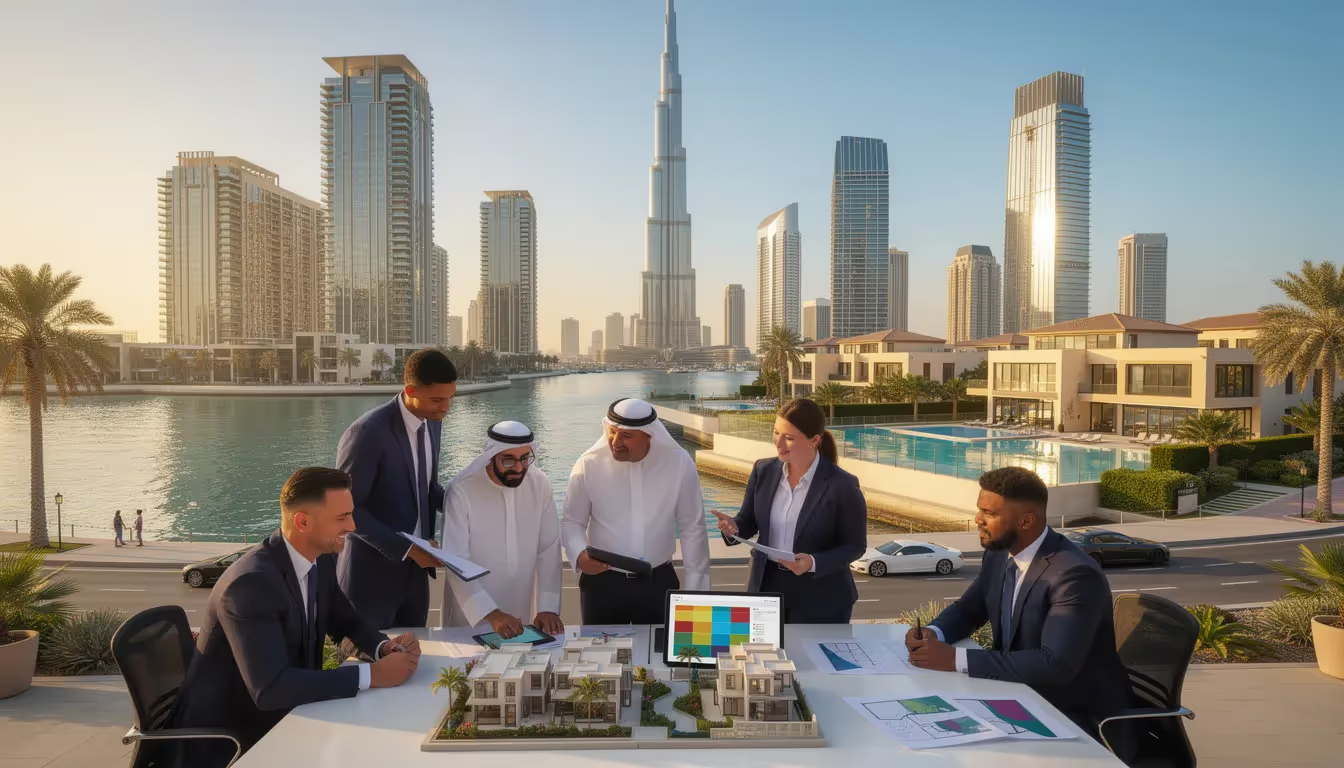

Money Transfers for Property Purchases in Dubai: Banks, Compliance, and Secure Payment Methods
Money transfers for real estate purchases in Dubai: payment methods, bank compliance, source of funds, escrow, and key information for buyers from Germany, Austria, and Switzerland.
Buying property in Dubai requires not only a solid market analysis, but also a clear understanding of payment methods, compliance requirements, and the risks associated with cross-border money transfers. This guide explains how buyers from Germany, Austria, and Switzerland can arrange money transfers for a Dubai property safely and in compliance with regulations.
Last updated: September 29, 2026
Key Takeaways
Money transfers for purchasing property in Dubai are highly regulated and do not follow one universal process. Property buyers should understand the following points from the outset:
- Payments in AED: Payments for property purchases in Dubai generally need to be made in AED. Depending on the type of transaction, payments may be processed via international bank transfer, through a Trustee Office, or into a project-specific escrow account for off-plan projects.
- AML and compliance checks: Anti-money laundering checks and proof of the origin of funds, such as Source of Funds and Source of Wealth documentation, commonly play a role when transferring money for a Dubai property. Buyers may be required to provide evidence showing where the money comes from.
- No standard process: Payment methods, documentation requirements, and bank procedures vary depending on the bank, developer, project type (off-plan vs. ready property), and buyer profile.
- Verify recipient details: Buyers from Germany, Austria, and Switzerland should verify recipient and payment details through independent official channels such as the Dubai Land Department (DLD) before transferring large amounts.
- Not legal advice: This article does not replace legal or tax advice. For transaction-specific questions, buyers should consult their own bank, a local lawyer, or a tax advisor. Buyers do not need a UAE residence permit to purchase property. However, foreign nationals may generally purchase property only in designated freehold areas.
How Is Property in Dubai Paid For?
The payment process for purchasing property in Dubai differs depending on the type of transaction. For a ready property, ownership transfer typically takes place through a Trustee Office licensed by the Dubai Land Department. On the so-called “Trustee Day,” the Trustee Office coordinates the Title Deed transfer. Ownership is officially registered through a Title Deed with the DLD. Buyer and seller sign a purchase agreement, such as an MoU or SPA, before the transfer takes place. Law No. 7 of 2006 regulates real estate registration in Dubai.
For off-plan properties, meaning projects that are still under construction, the purchase price is paid in installments according to a payment plan specified in the Sales & Purchase Agreement (SPA). Payments for off-plan properties are made into an escrow account. Real estate regulation in Dubai is supervised by RERA.
Banks, developers, and Trustee Offices may only accept purchase payments if applicable regulatory requirements are met. One of the relevant legal frameworks is UAE Federal Decree-Law No. 20 of 2018 concerning anti-money laundering. Property purchases must be registered with the Dubai Land Department. Larger purchase-price payments are generally made through bank transfers. Cash payments do not play a significant role in normal property transactions.
What Payment Methods Are Available?
In practice, buyers may use several different payment methods. The most important include:
International bank transfer: Buyers from Germany, Austria, and Switzerland commonly arrange international SWIFT transfers in AED. Sender and recipient details should match the purchase agreement and the information provided by the developer or DLD exactly. International bank transfers typically take around 2 to 5 business days. Actual processing times may vary depending on the bank and correspondent banking chain.
Local UAE bank transfer: Buyers with a bank account in Dubai or Abu Dhabi may transfer funds locally in AED. The process differs depending on whether payment is being made to the seller's personal account or to a corporate account belonging to a developer or Trustee Office.
Direct payment to the developer: For off-plan projects, payments are often made according to the SPA directly to the account specified by the developer. Payment plans are project-specific. Payment instructions should always be checked against official documentation.
Trustee payment: DLD-licensed Trustee Offices coordinate payments during ownership transfers. The purchase price may need to be presented in the form of a Manager's Cheque during the transfer. Whether additional bank transfers are accepted depends on the requirements of the specific Trustee Office.
Escrow account for off-plan properties: Under DLD and RERA rules, many registered off-plan projects are required to maintain project-specific escrow accounts. Escrow accounts are used for payments made to developers. However, not every property transaction necessarily uses an escrow account. The distinction between off-plan and ready properties is therefore important.
What Is “Source of Funds”?
Source of Funds (SoF) refers to the specific origin of the money being used for a particular transaction. Banks, developers, real estate brokers, and Trustee Offices in the United Arab Emirates may be required under AML rules to obtain information about the origin of funds, particularly for high-value transactions such as property purchases in Dubai.
Source of Funds typically answers questions such as: Which account is the money coming from? Does it come from salary savings, the sale of another property, an inheritance, or business profits? For example, someone who sells an apartment in Germany and uses the proceeds to purchase property in Dubai could document that sale as their Source of Funds.
There is no single standardized list of documents that applies to every bank and every transaction. Being asked to provide Source of Funds documentation does not mean the buyer is under suspicion. It is part of standard compliance procedures used by international banks.
What Is “Source of Wealth”?
Source of Wealth (SoW) describes how a buyer accumulated their overall wealth over time, for example through business success, long-term salary savings, the sale of company shares, or inheritance. The main difference is that Source of Funds concerns the specific money being used for a particular transaction, whereas Source of Wealth looks at how the buyer built their overall financial position.
Source of Wealth requirements may become especially relevant for customers with higher-risk profiles, politically exposed persons (PEPs), or buyers with complex asset structures. Requirements are generally based on FATF recommendations and guidance from the UAE Financial Intelligence Unit.
Possible supporting documents may include long-term company financial statements, agreements relating to the sale of business interests, or evidence of long-term employment or professional activity. The exact documentation required depends on the bank and its risk assessment of the customer.
What Documents Can Banks Request?
Documentation requirements vary depending on the bank, country, buyer profile, transaction size, and risk classification. There is no universal list. Mortgages in Dubai require additional documents such as proof of income. Buyers considering financing should understand the requirements and process involved in obtaining property financing in Dubai.
Typical document types mentioned in official guidance, including the UAE Central Bank AML Rulebook, may include recent bank statements, salary slips, employment contracts, company documents such as commercial register extracts and audited financial statements, purchase or sales contracts such as documentation relating to the sale of property in Germany or Switzerland, investment account statements, and documentation relating to gifts or inheritances.
Documents may be reviewed both in the buyer's home country and in the UAE. Buyers should therefore expect that both their European bank and the UAE-side institutions may request information. In some cases, certified English translations may be requested. However, this is not an absolute rule. Recommendation: contact your bank early and clarify which documents may be required for large international transfers in order to avoid delays later in the process.

Why Are Compliance and AML Checks Required?
The UAE real estate sector is subject to a strict AML/CFT framework. Relevant legal foundations include Federal Decree-Law No. 20 of 2018 and Cabinet Decision No. 10 of 2019. Real estate is considered a risk-sensitive sector internationally because it involves large amounts of money and cross-border capital flows.
Banks, real estate brokers, developers, and trustees in the UAE may be classified as Designated Non-Financial Businesses and Professions (DNFBPs) and are subject to AML obligations, including customer identification, risk assessment, suspicious transaction reporting, and document verification for real estate transactions. Compliance checks are not an accusation of wrongdoing. They are part of regulatory obligations.
The main objectives include preventing money laundering and terrorist financing, complying with international sanctions, and protecting the integrity and reputation of the UAE real estate market. Transparency is a central principle in these processes.
Transferring Money From Germany, Austria, or Switzerland to Dubai
Buyers from the DACH region frequently transfer large amounts of money for property transactions in several installments. The exact process depends on the bank.
Sender and recipient details: The name and address of the recipient, such as the developer, seller, or Trustee Office, must match the details provided in the agreement or official DLD documentation. IBAN, SWIFT/BIC, and the receiving bank name should be checked carefully. International payments should be initiated sufficiently in advance of the scheduled transaction date.
Payment reference: A precise payment reference is important so that the developer or Trustee Office can correctly allocate the payment. An example might be “Unit 1205, Tower X, Palm Jumeirah, SPA No. …”. The SPA often specifies which payment reference should be used.
Recipient verification: Bank details should only be obtained from official sources such as the purchase agreement, the Dubai REST App, the developer's official website, or written communication from a known corporate email address. If payment details change, buyers should always verify the new information using a second independent official channel.
Compliance at the buyer's home bank: Banks in Germany, Austria, and Switzerland may ask additional questions or request supporting documents before approving large international transfers. Inform your bank about the planned Dubai property purchase in advance and ask whether internal approval procedures will be required.
Currency conversion: Many payments must be made in AED. Whether currency conversion occurs through the sending bank, receiving bank, or another transfer provider depends on the chosen payment route. Final costs may be affected by exchange-rate spreads applied by the bank. Providers such as Wise may offer transparent exchange rates and fee structures. Buyers should compare different transfer solutions carefully.
Timing: International payments can take different amounts of time depending on the bank, correspondent banking route, and compliance checks. Do not schedule payments for the last possible day. Build in sufficient time buffers and plan international payment strategies in advance.
EUR to AED: Exchange Rates and Currency Risk
Buyers from the eurozone typically earn or hold their wealth in euros but pay for their Dubai property in AED. The UAE dirham is pegged to the US dollar. The official exchange rate has remained approximately AED 3.6725 per USD for decades and is supported by the Central Bank of the UAE.
For investors from Germany, Austria, and Switzerland, this means that EUR/AED exposure is largely driven by EUR/USD movements. Currency fluctuations can increase or reduce the euro-equivalent cost of a Dubai property even if the AED purchase price itself remains unchanged.
This can be particularly relevant for off-plan projects with payment plans extending over two or three years, for example projects on Palm Jumeirah or in Downtown Dubai. The currency risk should be considered across the entire payment period. This is especially relevant when an off-plan mortgage is used during construction. Potential approaches for limiting currency risk, such as staggering currency conversions, may be discussed with the buyer's bank. Predictions about the “right time” to exchange currencies are inherently uncertain because exchange rates fluctuate.
Off-Plan Properties and Escrow Accounts
Off-plan properties are developments that are still under construction. The buyer purchases a property that will be handed over at a later date. Escrow accounts play an important role in Dubai's regulatory framework for off-plan property purchases and are an important part of the security mechanisms for buying property in Dubai.
DLD and RERA require registered off-plan projects to maintain project-specific escrow accounts. Customer payments are collected in these accounts and released to developers according to applicable rules and verified construction progress. At least 20% construction progress may need to be achieved before certain funds can be released from the escrow account. Popular areas for off-plan developments include Palm Jumeirah, Downtown Dubai, and Business Bay.
Before making any payment, buyers should verify that the project is registered with the DLD and that the escrow account details correspond with official developer documentation. The Dubai REST App and DLD website provide official channels that can be used for independent verification. The exact structure of the payment plan, whether linked to construction milestones or fixed dates, depends on the individual project and developer.

Ready Property: How Does Payment Work During the Transfer?
For ready properties, such as an apartment in Dubai Marina or a villa in Arabian Ranches, ownership transfer typically takes place through a DLD-licensed Trustee Office. Dubai Marina is particularly popular among international professionals and offers a wide range of properties for buyers looking to buy an apartment or property in Dubai.
At the Trustee Office, the parties coordinate Form F / MOU or the purchase agreement, DLD fees, and the purchase-price payment. The DLD transfer fee is approximately 4% of the purchase price. Additional Trustee Office fees may apply, for example around AED 4,200 including VAT for properties above AED 500,000. DLD registration fees may be approximately AED 2,000 to AED 4,000.
Many transactions use a combination of payment methods, such as bank-certified cheques for the purchase price and fees, together with bank transfers. There is no single payment method legally prescribed for every transaction. In practice, the steps are coordinated between the banks, Trustee Office, buyer, and seller.
For properties with an existing mortgage, additional steps may be required, including a Liability Letter and repayment of the existing mortgage. International buyers generally need a down payment of around 20% to 30% for mortgages, while banks may finance approximately 50% to 75% of the property value for foreign buyers. Transactions involving financing may be particularly time-sensitive, so buyers should coordinate with both banks early and understand how financing affects the overall profitability of a Dubai property investment.
How Should Payment Details Be Verified Before a Transfer?
Large international property transfers are often difficult or impossible to reverse. Careful verification is therefore essential.
Recipient name: The recipient name should match exactly the legal name shown in the SPA, MOU, or DLD documentation, for example “XYZ Real Estate Development LLC” rather than only the company's trading name. IBAN, account number, and SWIFT/BIC should be compared against the original documentation several times.
Developer or company identity: Verify whether the developer or broker is licensed with the Dubai Land Department or RERA. This can be checked using the Dubai REST App or official DLD channels. If payments are being requested to a third party, confirm that the purchase agreement explicitly permits that payment method.
Project and account verification: For off-plan projects, buyers should verify the project registration and escrow account details through official DLD channels. If banking details are changed, always request confirmation through a second independent official communication method.
Payment reference: Ensure that the unit number, project name, and contract number are included in the payment reference when required so the payment can be allocated correctly.
Archive payment records: Keep systematic records of transfer confirmations and bank statements. These documents may later be required by the bank, developer, DLD, or tax authorities.
Fraud Risks When Buying Property
Large financial transactions naturally attract fraud attempts. Dubai's real estate market is highly regulated, but buyers should still be aware of potential risks.
Typical risks may include fraudulent payment instructions, for example when the email account of a broker or developer is compromised and the buyer receives supposed “new bank details.” Identity fraud and impersonation are also known risks. Fraudsters may claim to be representatives of well-known developers or Trustee Offices. Pressure to transfer money quickly without sufficient time to verify the payment details should also be treated as a warning sign.
Potential red flags include accounts located in third countries or payments requested to personal accounts even though the contract is with a Dubai-based company, communication suddenly switching to private email addresses, or payment instructions that differ from those specified in the SPA. Buyers seeking to build wealth over the long term should take fraud prevention just as seriously as the fundamentals of healthy, sustainable wealth building with Dubai real estate.
Only make payments to accounts specified in the contract or in official DLD documents. If in doubt, contact the developer or Trustee Office using the main phone number or email address listed on the official website rather than using the contact details contained in a suspicious email. When there is uncertainty, accepting a short delay is usually safer than making an unverified payment.
What Costs Can Arise During a Money Transfer?
In addition to the purchase-related costs such as DLD fees, broker commissions, and NOC fees, bank and currency-related costs may arise when transferring money for a Dubai property. Buyers should generally budget approximately 7% to 10% of the purchase price for additional transaction costs. These costs can directly affect the realistically achievable return on a Dubai property investment.
- DLD transfer fee: Approximately 4% of the purchase price
- Broker commission: Usually around 2% of the purchase price
- DLD registration fee: Approximately AED 2,000 to AED 4,000
- Trustee fees: Vary depending on the Trustee Office, for example around AED 4,200
- Transfer fees charged by the sending bank: Flat or tiered, depending on the bank
- Correspondent bank fees: May arise along the SWIFT payment chain
- Exchange-rate spread: The difference between the mid-market exchange rate and the rate offered by the bank
- Receiving-bank fees: May apply depending on the Dubai bank receiving the transfer
International transfers can generate significant fees. Before making large payments, buyers should request written information about the applicable fee structure and exchange-rate margin.
Typical Mistakes Made by Buyers From DACH Countries
Many of the common mistakes when buying property in Dubai are related to payments and compliance. Buyers should avoid:
- Transferring the full amount before verifying the recipient and account details through official channels.
- Using an incorrect or incomplete payment reference.
- Underestimating AML and compliance checks at their home bank.
- Submitting required documents too late.
- Transferring large amounts from accounts where the beneficial owner is not clearly documented.
- Waiting until just before the contractual payment deadline.
- Assuming all banks and developers follow the same procedures.
- Failing to keep systematic documentation and payment records.
Good preparation, early communication with the bank, and organized documentation can help prevent many of these problems.
Pre-Payment Checklist for Dubai Real Estate
Use this checklist immediately before making a major payment:
- ☐ Purchase agreement / SPA / MOU fully reviewed and payment plan understood
- ☐ Payment dates and amounts, including DLD, NOC, and Trustee fees, recorded and sufficient time buffer included
- ☐ Recipient, developer, seller, Trustee Office, and project verified through official DLD/RERA channels
- ☐ Account details including IBAN, SWIFT, and bank name compared with original documentation
- ☐ Any changes to account details confirmed independently
- ☐ Source of Funds and, if applicable, Source of Wealth documents prepared for the bank
- ☐ Developer or UAE bank requirements concerning the origin of funds clarified in advance
- ☐ EUR/AED exchange-rate risk for the total investment understood and, where appropriate, discussed with a financial advisor
- ☐ International transfer limits and procedures checked with the buyer's own bank
- ☐ Process established for archiving transfer receipts, bank statements, and confirmations
FAQ
The following are common questions from buyers in Germany, Austria, and Switzerland about transferring money for Dubai property purchases.
How Do I Transfer Money to Dubai for a Property?
The standard method is an international SWIFT bank transfer in AED to the account specified in the purchase agreement. Depending on the transaction, this may be the developer, seller, Trustee Office, or escrow account. Before making the transfer, clarify with your bank how large international payments are approved and which documents are required for AML and compliance. The exact process, such as whether payment can be initiated through online banking or requires a branch visit or additional signatures, depends on the individual bank.
Can I Transfer Euros Directly to Dubai?
Many European banks allow EUR transfers to the UAE. Conversion to AED may be carried out by the receiving bank or through correspondent banks. However, many developers and Trustee Offices specifically require payment in AED. Before making the first payment, clarify in writing whether EUR payments are accepted or whether payment must be made in AED.
What Does “Source of Funds” Mean When Buying Property in Dubai?
Source of Funds refers to the immediate origin of the money being used for the transaction. Examples include accumulated salary savings, proceeds from selling a property, and business profits. Because of AML rules, regulated institutions in the UAE may require evidence of the source of funds, especially for large transactions. Requirements differ depending on the bank and buyer risk profile.
Does an Off-Plan Payment Have to Be Made to an Escrow Account?
DLD and RERA require escrow structures for registered off-plan developments, through which customer payments are held and administered. The relevant account details are generally included in the SPA. However, the exact payment structure depends on the project. Buyers should verify the account information in the contract using official DLD sources and, if necessary, contact a licensed RERA broker or the DLD directly.
Can My Bank Stop or Block a Transfer to Dubai?
Yes. Banks in Germany, Austria, and Switzerland may delay, hold, or reject payments under national and international AML and sanctions regulations if required information is missing or potential risks are identified. This may occur, for example, when proof of Source of Funds is unclear or when a payment triggers a sanctions-screening review. Inform your bank about the planned property purchase in advance and prepare the relevant documentation.
Additional information: Dubai does not currently levy an annual property tax comparable to those found in many European jurisdictions. There is also generally no personal tax on rental income or capital gains from property sales under the UAE personal tax framework. These tax characteristics are one reason Dubai attracts international property investors. Average gross apartment yields are often cited at around 7%, although actual rental yields depend heavily on property type, purchase price, location, service charges, occupancy, and market conditions. This helps explain why investing in Dubai real estate may be viewed as a long-term investment opportunity. Dubai also receives more than 15 million international visitors annually and offers extensive transport, tourism, financial, and residential infrastructure. Among the best-known areas are Downtown Dubai, Palm Jumeirah, and Dubailand, which is increasingly positioned as a family-oriented residential and investment location. An investor residence visa may be available for qualifying property investments starting from approximately AED 750,000. A two-year renewable residence visa may allow eligible investors to sponsor certain family members. The UAE Golden Visa may be available for qualifying property investments of at least AED 2 million. Investors considering long-term residence should therefore understand the applicable Golden Visa requirements for Dubai real estate investors. Property-related residence applications may be processed through the Dubai Land Department and other relevant UAE authorities depending on the specific visa category. For all property investments, long-term returns and benefits depend heavily on selecting suitable locations, evaluating the property carefully, and understanding the investment strategy.
Editorial Notes, Author Information & Updates
This article was created for blog.lifeinluxury.de and is intended for property buyers and investors from German-speaking countries. All legal and banking information is based, to the best of our knowledge, on publicly available primary sources such as the UAE Central Bank, Dubai Land Department, UAE AML legislation, and official government information. This article does not constitute legal or tax advice.
Author: Life in Luxury Editorial Team – Dubai Real Estate Division
Last updated: September 29, 2026
Sources & Further Information
The following primary sources form the main basis for the information contained in this article:
- UAE Central Bank (CBUAE): Information relating to the AED, the USD currency peg, AML regulations for financial institutions, and Rulebook guidance relating to Source of Funds, Source of Wealth, and real estate-sector considerations.
- Dubai Land Department (DLD): Official websites and the Dubai REST App for project and escrow verification, regulations relating to Registration Trustee Offices, and escrow account rules.
- UAE Financial Intelligence Unit (FIU) / Ministry of Economy: Guidance and supplementary information relating to AML, Source of Funds, and Source of Wealth requirements in the real estate sector.
- Federal Decree-Law No. 20 of 2018 and related Cabinet Decisions, including Cabinet Decision No. 10 of 2019, concerning anti-money laundering requirements.
- FATF reports concerning the UAE: Used as international background regarding the country's AML framework.
For specific transactions, buyers should also consult the most recent documentation provided by their own bank, developer, and Trustee Office because processes, forms, and requirements may change. Further information about technical terms and services relating to property purchases, ownership rights, service charges, and Dubai real estate can be found in related articles on blog.lifeinluxury.de, including content concerning off-plan properties, off-plan projects, investor visas, Golden Visas, and area guides covering Dubai Marina, Downtown Dubai, and Palm Jumeirah.

Lukas Reinhardt
Editorial team
Lukas Reinhardt is a real estate writer focusing on international residential properties, investment locations, and the Dubai real estate market. He covers purchasing processes, location factors, market trends, and the regulatory framework relevant to buyers and investors from the DACH region.
.jpg)
Individual financing for Dubai real estate
We work with selected partner banks in the UAE and structure your financing individually — tailored to your budget, equity and investment goals.
100% no obligation
Investment advice for Dubai real estate
We analyze which projects offer the best potential for long-term rental income or sustainable capital appreciation. Whether off-plan or ready-to-move, we develop a clear investment strategy tailored to your specific situation.
Personalized investment strategy for Dubai real estate
Develop a tailored investment strategy for real estate in Dubai based on your needs, goals and risk profile. Get clear advice to get the best return on investment.
100% non-binding


.avif)